

Multi-Site Network Management: Templates, Shared Components, and Local Autonomy
Scale your global digital presence with a unified framework that balances centralised brand governance and regional autonomy through shared templates and reusable component libraries.
Many organisations manage a growing network of websites. A corporate site often expands into regional versions, campaign landing pages, and brand-specific microsites. Each environment has a different purpose and is often maintained by separate teams.
The scale of these ecosystems continues to expand, with the global web content management market valued at over $12 billion and projected to grow significantly as organisations increase investment in digital platforms.
As the number of sites increases, coordination becomes more difficult. Teams create similar pages independently, adapt layouts to local needs, and introduce variations in structure and design. Research shows that 61% of teams still rely on multiple CMS platforms across regions or departments, which increases duplication and operational complexity.
Without a clear approach to multi-site management, these differences accumulate and create inconsistencies across the site network.
In this situation, website network management becomes necessary. It provides a framework for managing multiple sites within a shared platform, allowing teams to publish content independently while maintaining a consistent structure. Templates, components, and governance rules define how pages are built and updated across the network.
A well-structured system balances central control with flexibility. This balance helps manage large site ecosystems while maintaining consistent brand and user experience across all digital properties.
What Multi-Site Management Means
Multi-site management is the approach to operating multiple websites, brands, or regional versions within a single platform, using shared infrastructure, templates, and governance rules. It defines how sites are created, structured, and maintained across an organisation while allowing different teams to manage their own content.
Within website network management, this approach creates a coordinated environment where all sites rely on the same foundation. Templates define page structure, a shared component library standardises layout elements, and governance rules regulate how changes are introduced. Each site remains part of a larger system instead of an isolated environment.
This model differs from managing separate websites independently. In a fragmented setup, each site develops its own templates, components, and workflows. This inevitably leads to duplicated work, inconsistent design, and increased maintenance. Multi-site systems reduce this fragmentation by introducing shared building blocks and centralised control.
A structured multi-site setup also supports scalability. New sites, microsites, or regional versions can be launched using existing templates and components instead of building everything from scratch. This helps teams move faster while maintaining consistent structure across the network.
At the same time, the model does not eliminate flexibility. Local teams continue to manage content, campaigns, and regional adaptations. The platform defines the boundaries, while editorial teams operate within them. This allows organisations to expand their digital presence without losing control over structure, performance, or brand consistency.
The Core Challenge: Central Control vs Local Autonomy
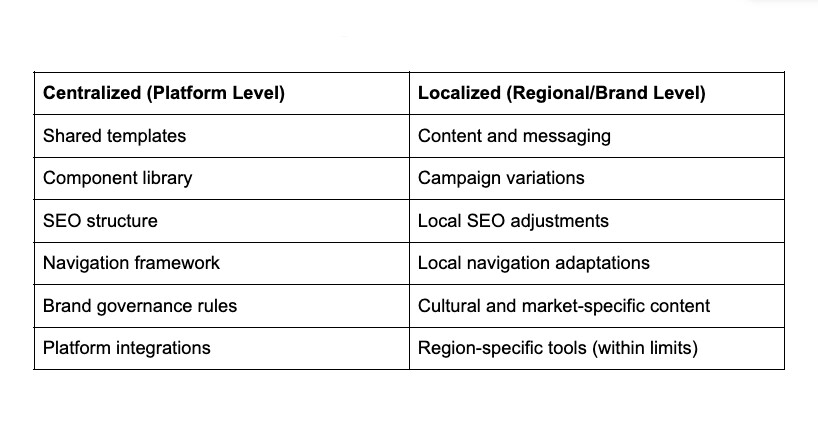
The demand for managing growing volumes of digital content continues to rise across industries, driving expansion of content management systems and increasing operational complexity. Managing a network of websites requires a clear separation of responsibilities between central and local teams. Without this structure, platforms either become inconsistent or too rigid for regional use.
Central teams are responsible for the foundation of the platform. This includes templates, the component library, core SEO rules, and governance standards. These elements define how pages are built and ensure consistency across all sites.
Regional teams focus on content and execution. They manage localised messaging, campaign pages, and market-specific updates. This is where regional autonomy applies, allowing teams to adapt content without modifying the underlying structure.
A well-designed system aligns these layers without conflict. The key is to define which elements are fixed and which can be adjusted. Structural components remain controlled at the platform level, while content and campaigns are handled locally.
Building Blocks of Multi-Site Management
A stable multi-site system depends on a set of shared elements that define how websites are created and maintained. These elements allow multiple teams to work within the same platform while maintaining consistency across all sites.
Shared Templates
Shared templates define the structure of pages across the entire site network. They control layout, content regions, and core page elements such as headers, navigation, and metadata fields. Each site relies on the same template structure, which ensures consistency in how pages are built.
Templates also support faster rollout of new pages. When a new regional site or campaign page is required, teams can use existing templates instead of creating layouts manually. This reduces development effort and keeps the user experience aligned across all sites.
Within multi-site management, templates are typically organised in a hierarchy. Core templates define global page types, while variations support specific use cases without changing the underlying structure. This allows flexibility without introducing fragmentation.
Component Library
A component library provides reusable building blocks that editors use to assemble pages. These components include elements such as banners, product grids, content sections, and call-to-action blocks.
Each component follows predefined design and behaviour rules. Editors can combine them to create different page layouts while maintaining consistent visual and functional patterns. This reduces the need to recreate similar elements across multiple sites.
The library also helps prevent duplicated work. Teams reuse the same components across brands and regions instead of building new ones for each site. Updates to a component can be applied across all instances, which simplifies maintenance within website network management.
Brand Governance
Brand governance defines how visual identity, tone of voice, and content structure are maintained across all sites. It includes design systems, content guidelines, and approval rules that regulate how pages are presented.
In a multi-site environment, governance ensures that each site follows the same standards while allowing localised content. Regional teams adapt messaging for their markets, but design elements and layout patterns remain aligned.
Governance rules are often integrated into templates and components. This allows the platform to enforce standards automatically during content creation, reducing the need for manual review.
Centralised Back Office
A centralised back office provides a single environment for managing the entire site network. Templates, components, permissions, and workflows are controlled within the shared system.
This setup allows platform teams to update structural elements once and apply changes across multiple sites. It also simplifies administration by consolidating management tasks into one place.
Within multi-site management, the centralised back office supports coordination between teams. It provides visibility into site activity, controls access through permissions, and maintains consistency across all digital properties.

The Core Challenge: Central Control vs Local Autonomy
Corporate Website with Regional Versions
A global corporate website often serves as the foundation for multiple regional sites. The core structure remains consistent across all markets, supported by templates and a centralized component library. Navigation, page hierarchy, and key content types follow the same logic across the network.
Regional teams manage localised content within this structure. Language, promotions, and market-specific messaging are adapted without changing layout or functionality. This approach helps maintain consistency while supporting local relevance.
Within website network management, updates to templates or components can be applied across all regions at once. This reduces maintenance effort and keeps the platform aligned as new markets are added.
Campaign Microsites
Campaign microsites require fast deployment and controlled variation. Marketing teams often need to launch pages for seasonal promotions, product launches, or partnerships within tight timelines.
A structured system supports this by using predefined templates and components. Teams construct pages using the existing library, which ensures visual consistency and predictable behaviour. This supports microsite governance by limiting structural changes while allowing flexible content.
New microsites can be launched without creating separate systems. They remain part of the same platform, managed through a centralised back office, which simplifies tracking and updates across campaigns.
Multi-Brand Website Platform
Organisations that manage multiple brands often operate within a single platform. Each brand has its own identity, yet all brands rely on the same technical foundation.
A multi-brand website platform uses shared infrastructure, templates, and components while allowing controlled variation in design and content. Brand-specific styles are applied within predefined rules, which are enforced through governance.
This setup allows teams to manage several brands without duplicating systems. Shared elements reduce development effort, while brand-level customisation supports distinct positioning. Within multi-site management, this model supports growth without increasing platform complexity.
When Multi-Site Management Fails (and How to Avoid It)
Multi-site management fails when structure is not enforced at the platform level. Teams begin to introduce local variations that are not aligned with shared standards, and the site network gradually becomes harder to maintain.
A common issue is the duplication of templates. Different teams create similar page structures instead of using templates, which leads to inconsistencies and higher maintenance effort. Updates must then be applied separately across multiple versions of the same layout.
Another failure point is the uncontrolled growth of components. Academic research on CMS ecosystems shows that added extensions and components increase system complexity and expand the potential attack surface when not properly governed.
Without a governed component library, teams introduce new elements for specific use cases. Over time, it results in overlapping components with similar functions, making it difficult to maintain a consistent user experience.
Lack of governance also contributes to fragmentation. When design rules and content standards are not enforced, visual identity and messaging begin to vary across sites. This reduces consistency across the network and weakens brand alignment.
Structural changes made at the local level create additional risks. When regional teams modify templates or navigation patterns, the platform loses its shared foundation. These changes often affect SEO structure and make future updates more complex.
These issues can be avoided by enforcing clear rules within multi-site management. Shared templates should define all page structures, while the component library should include only approved elements. Permissions in the centralized back office should restrict structural changes and limit access to core components.
Checklist: 10 Rules to Avoid Site Drift
This checklist supports stable website network management by defining clear rules for how sites are created and maintained.
1. Use shared templates for all page types across the site network.
2. Maintain a single component library with approved and reusable elements.
3. Restrict structural edits through permissions in the centralised back office.
4. Keep navigation structure consistent across all sites.
5. Apply brand governance rules to design, layout, and content patterns.
6. Limit creation of new components to controlled platform updates.
7. Standardise SEO elements such as metadata and page hierarchy.
8. Avoid duplicating templates or layouts for similar use cases.
9. Review sites regularly to identify inconsistencies or unauthorised changes.
10. Manage all sites within a unified multi-site management system.
Implementation Approach
A structured rollout of multi-site management requires clear sequencing. Each step builds on the previous one and reduces the risk of fragmentation as the site network grows.
1. Audit the existing site network
Start by reviewing all active sites, templates, and components. Identify duplicated layouts, inconsistent structures, and unmanaged elements. This provides a baseline for improving website network management.
2. Define the platform structure
Establish how sites will be organised within the system. This includes page types, navigation patterns, and relationships between global and local content. The goal is to create a consistent structure that applies across all sites.
3. Create shared templates
Design shared templates for key page types such as landing pages, product pages, and content sections. These templates should define layout and required elements while allowing content variation.
4. Build a component library
Develop a controlled library with reusable elements. Each component should follow defined design and behaviour rules. Limit the introduction of new components to prevent duplication.
5. Establish brand governance rules
Define how design, content, and layout standards are applied across sites. Governance should be embedded into templates and components so that rules are enforced during content creation.
6. Configure roles and permissions
Set access levels for different teams within the centralised back office. Control who can edit content, create pages, or modify structural elements. This step protects the platform from unintended changes.
7. Enable regional autonomy within constraints
Allow local teams to manage content, campaigns, and localisation while keeping templates and components unchanged. This supports regional autonomy without affecting the shared structure.
8. Standardise publishing workflows
Define how content moves through drafting, review, and publication. Consistent workflows reduce errors and improve coordination across teams.
9. Migrate and consolidate sites
Move existing sites into the new structure. Replace duplicated templates and align pages with shared components. This step brings the entire network under a unified system.
10. Monitor and refine
Track how the system performs as new sites and campaigns are added. Adjust templates, components, and governance rules based on observed issues or new requirements.
FAQ
What is multi-site management?
Multi-site management is the approach to operating multiple websites within a shared platform. It defines how templates, components, and governance rules are applied across brands, regions, and microsites while allowing teams to manage their own content.
How is website network management different from managing separate sites?
Website network management coordinates multiple sites within a single system. Separate site management treats each website as an independent environment, which increases duplication and makes updates harder to maintain across the network.
What are shared templates and why are they important?
Shared templates define how pages are structured across all sites. They ensure consistency in layout and reduce the need to recreate page structures for each new site or campaign.
What is a component library in multi-site systems?
A component library is a collection of reusable elements used to build pages. These components follow predefined rules, which helps maintain consistent design and behaviour across the site network.
How does brand governance work across multiple sites?
Brand governance defines rules for design, content, and layout. These rules are enforced through templates and components, ensuring that all sites follow the same standards while allowing localised content.
How do you allow regional autonomy without breaking structure?
Regional autonomy is supported by limiting local control to content and campaigns. Templates, components, and structural rules remain managed at the platform level, which keeps the system consistent.
What is microsite governance?
Microsite governance controls how campaign or temporary sites are created and managed. It ensures that microsites follow the same templates and components as the main platform while allowing content variation.
Can multi-site management reduce duplicated work?
Multi-site management reduces duplicated work by using templates and reusable components. Teams build pages using existing elements instead of creating new ones for each site.
Get in touch
- Telephone Number: +1 (425) 247-0867
- Email Address: [email protected]