

Website Governance at Scale: How to Run a Site Network Without Chaos
Master website governance to prevent site drift and protect SEO integrity. Learn how to manage large site networks using centralised templates and structured workflows for brand consistency and accessibility at scale.
Large organisations often operate dozens or hundreds of websites, part of a global web ecosystem that now includes more than a billion sites worldwide. Corporate domains coexist with regional sites, campaign pages, product microsites, and partner portals. Each team contributes content, launches campaigns, and updates pages across this network. Corporate websites increasingly function as the digital footprint of organisations and are widely used to assess their digital capabilities. As activity grows, maintaining consistency becomes difficult.
This is where website governance becomes necessary. Governance defines how websites are structured, who can modify them, and how publishing decisions move through an organisation. Within enterprise website management, governance provides the operational framework that allows distributed teams to work independently whilst maintaining a stable platform.
Without governance, site ecosystems tend to drift. Templates diverge between regions, plugins accumulate without coordination, and page structures develop differently across sites. Small variations eventually turn into structural fragmentation. Maintenance becomes expensive, SEO signals weaken, and brand consistency across regions becomes harder to maintain.
A governance model addresses these risks by introducing controlled templates, reusable components, structured roles and permissions, and a defined publishing workflow. Editors still create and update content, yet the system protects layout structure, metadata standards, and accessibility requirements. This balance allows organisations to run web operations at scale without creating operational chaos.
Website Governance: Practical Implications
Website governance is the system of policies, platform controls, and operational procedures that regulate how websites are structured, edited and published across an organisation. It defines how templates evolve, who can modify content, and how changes move through approval stages. Within enterprise website management, governance creates a controlled environment where distributed teams can update websites without weakening structure, SEO integrity, or brand standards.
Large organisations often operate corporate domains, regional sites, microsites and campaign pages maintained by different teams. Without governance, page structures, plugins and layouts gradually diverge across the network.
The Reasons Behind Website Network Divergence
Large site ecosystems tend to lose structural alignment as editorial activity increases. Each team adds pages, adapts layouts, and introduces local adjustments that serve immediate needs. Without governance controls, these changes accumulate and create inconsistencies across the site network. The result affects usability, brand presentation, SEO stability, and long-term maintainability.
Several operational patterns commonly contribute to this problem.
Template Fragmentation
Templates define the structural logic of pages. They control layout, navigation elements, metadata fields, and content structure. In large organisations, templates are often duplicated to accommodate specific campaigns or regional requirements.
When teams copy templates instead of extending a shared base, multiple versions begin to appear across the platform. Small layout adjustments become embedded in those duplicates. As new features or fixes are introduced, updating every variant becomes difficult. Some sites continue using outdated structures while others move forward with revised layouts.
Plugin and Integration Sprawl
Many websites grow through incremental additions. Teams install plugins to solve immediate problems such as analytics tracking, form management, or campaign features. Over time, the number of integrations increases across different sites within the network.
Uncoordinated extensions introduce multiple risks. Research shows that a large share of websites depend on external infrastructure providers such as DNS, CDNs, or certificate authorities, increasing operational complexity. Plugins may conflict with each other, duplicate functionality, or rely on incompatible dependencies. Security exposure also increases when several third-party tools require updates and monitoring.
Uncontrolled Access and Permissions
Large editorial teams require flexible access to the platform. Without a defined structure for roles and permissions, editors often receive elevated privileges that allow structural edits. Page layouts, template fields, or SEO configurations can then be modified unintentionally.
These patterns demonstrate why large site ecosystems require structured multi-site governance. Governance mechanisms provide the controls needed to maintain structural alignment whilst allowing distributed teams to continue publishing efficiently.
How to Prevent Website Degradation
The quickest way to prevent site drift is to enforce structural rules directly within the platform. Governance mechanisms, such as centralised templates, controlled components and structured permissions, keep large site networks aligned whilst multiple teams contribute content.
A governed page builder reinforces these rules during content creation. Editors assemble pages using approved blocks that follow predefined design and accessibility patterns. These blocks allow flexibility in page composition whilst protecting layout integrity and technical standards.
Access control also plays an important role. Clearly defined roles and permissions determine which contributors can modify structural elements and which can update content fields. Platform administrators maintain templates and configuration, whilst editorial teams focus on publishing content within the approved structure.
A structured publishing workflow adds an additional layer of protection. Content passes through review and approval stages prior to publication. Reviewers validate compliance with brand guidelines, SEO requirements and regulatory policies. This process reduces the likelihood of structural inconsistencies appearing across the site ecosystem.

Governance Model: Templates, Blocks, Permissions, Approvals
A governance model embeds governance rules into the platform through templates, components, permissions and workflows. This approach allows many editors to publish content whilst protecting the structural integrity of the site network.
Template Governance
Templates define the foundation of page structure. They control layout regions, navigation placement, metadata fields and the relationship between content sections. When templates are centrally managed, each site in the network follows the same structural logic.
A governance framework usually introduces a hierarchy of templates. Core templates establish global page structures such as product pages, landing pages or content hubs. Regional or campaign pages rely on these templates rather than creating independent layouts.
Central template governance improves stability across the network. Updates to accessibility patterns, metadata fields or navigation elements can be applied once and propagated across all pages that depend on the template. This practice supports multi-site governance whilst reducing maintenance complexity.
Governed Page Builder and Content Blocks
Editorial teams need flexibility to publish campaigns, product updates and marketing content quickly. A governed page builder allows this whilst also preserving structural control.
The page builder relies on modular content blocks. Each block represents a predefined content pattern such as a hero section, product grid, article preview or call-to-action banner. Editors assemble pages using these approved components.
The system prevents structural modifications that could disrupt layout rules. Editors select blocks, reorder them and update content fields without altering the underlying template. This mechanism supports content governance by standardising how content appears across pages.
Roles and Permissions
Access control forms another core layer of governance. Roles and permissions determine what actions each contributor can perform within the platform.
Editors typically receive access to create and modify content inside approved templates. Reviewers validate accuracy, brand compliance and legal requirements. Publishers approve final changes and trigger publication. Platform administrators manage templates, system configuration and structural elements.
The separation of responsibilities reduces the risk of accidental changes. Structural elements remain protected whilst editorial teams continue publishing content. In enterprise website management, a well-defined permissions model allows large editorial teams to collaborate without compromising platform stability.
Publishing Workflow
A defined publishing workflow organises how content progresses through preparation, review and release. Each stage introduces verification steps that protect quality and accuracy.
Content creation begins in draft form. Editors assemble pages using approved blocks and update relevant metadata. Reviewers examine the page for compliance with brand standards, legal requirements and SEO rules. Publishers approve the final version and schedule the release. This workflow reduces the likelihood of incomplete or incorrect content reaching production.
Structured workflows are particularly valuable in environments that operate web operations at scale, where multiple contributors may be preparing updates simultaneously across different sites. Governance mechanisms coordinate these activities and maintain consistent publishing standards across the entire site network.
SEO and Accessibility Governance
Large site ecosystems require consistent technical standards across every page. Editorial activity, campaign launches and regional updates create constant change. Without governance mechanisms that regulate SEO and accessibility, these updates may introduce structural inconsistencies that affect search visibility and usability.
Embedding governance rules directly into templates and platform logic allows organisations to maintain stable standards across large site networks. This approach supports enterprise website management by reducing the risk of technical regressions during daily publishing activity.
SEO Governance at Scale
Search visibility depends on consistent metadata, structured page hierarchy and predictable linking patterns. Large editorial teams can unintentionally disrupt these signals when SEO configuration depends on manual updates.
Governance mechanisms address this risk by integrating SEO controls into the platform. Template-level rules define metadata fields, canonical structures and indexing directives. Editors fill content fields while the system maintains consistent markup and metadata placement.
This structure supports content governance across large editorial environments. Page titles, descriptions and heading structures follow predefined rules that protect search visibility. Automated validation may also highlight missing metadata or structural issues before publication.
SEO governance becomes particularly valuable in environments with multi-site governance. Regional sites often share similar structures while publishing localised content. Central SEO rules maintain consistency across markets without limiting editorial autonomy.
Accessibility Guardrails
Accessibility requirements influence how websites present content and interact with users. Standards such as WCAG require structured markup, accessible navigation patterns and clear semantic relationships between page elements.
Accessibility governance integrates these requirements into templates and components. Approved templates already contain accessible markup structures. Content blocks follow defined patterns for headings, images and navigation elements. Editors provide content inside these structures without modifying the underlying accessibility framework.
Operating Model: Responsibilities and Ownership
Governance necessitates clear responsibility across teams. Large site ecosystems involve marketing departments, regional teams, product managers, legal reviewers, and platform administrators. Without defined ownership, publishing activity becomes difficult to coordinate and governance policies lose effectiveness.
An operating model clarifies how enterprise website management distributes responsibility amongst contributors. Each role participates in publishing activity whilst governance mechanisms regulate how decisions move through the system.
The structure often follows a responsibility framework that separates content creation, review, publication, and platform maintenance.
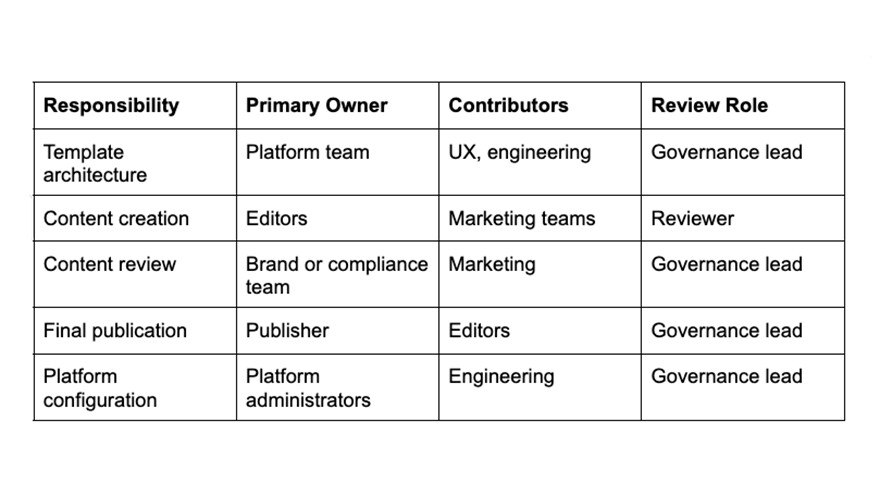
This operating model supports multi-site governance by allowing distributed teams to contribute content without disrupting platform structure. Editorial activity continues across regions whilst governance roles maintain consistent standards across the site network.
Clear ownership also improves accountability. Teams know who reviews content, who authorises publication, and who maintains structural elements of the platform. This reduces operational friction and supports stable web operations.
Implementation Playbook: Introducing Website Governance
Introducing governance across a large site network requires a structured rollout. Editorial teams continue publishing content during this process, so governance changes must integrate with existing workflows without disrupting daily activity. A phased implementation allows organisations to strengthen enterprise website management while maintaining operational continuity.
The following steps outline a practical approach for establishing website governance across multiple sites.
Step 1: Audit the Existing Site Network
Governance begins with visibility. Organisations need a clear inventory of their current site ecosystem before introducing structural controls.
The audit typically reviews:
- number of active websites and domains
- template variations across sites
- plugin usage and integrations
- editorial roles and access permissions
This analysis highlights inconsistencies in templates, permissions, and publishing routines. It also identifies areas where governance controls can improve stability across the network.
Step 2: Define Governance Policies
Governance policies determine how editorial activity should operate across the platform. These policies clarify ownership and decision authority.
Typical governance rules define:
- who maintains templates and structural components
- which teams can publish content directly
- which updates require review or approval
- how regional teams localise content
Clear governance policies help maintain alignment between editorial teams and platform administrators.
Step 3: Standardise Templates and Components
A stable template system forms the backbone of multi-site governance. Page structures should rely on shared templates and reusable components that support consistent layouts across all sites.
Templates define page hierarchy, navigation elements, and metadata fields. Shared components allow editors to assemble pages whilst following the same design patterns across the network.
Standardisation reduces maintenance complexity and simplifies updates when design or SEO rules change.
Step 4: Implement Roles and Permissions
Governance requires clear separation of responsibilities. Roles regulate who can edit content, review updates, or modify platform structure.
Editors usually receive access to content fields and page assembly tools. Structural configuration remains restricted to administrators or platform teams. This structure reduces accidental changes that could affect multiple sites.
Step 5: Introduce Structured Publishing Workflow
A defined workflow introduces verification before content reaches production. Draft pages move through review stages where editors, reviewers, and publishers validate the content.
Reviewers confirm alignment with brand guidelines, legal requirements, and SEO standards. Publishers authorise the final release of content.
This process reduces the likelihood of incomplete pages or structural issues appearing on live sites.
Step 6: Integrate SEO and Accessibility Controls
SEO and accessibility rules should reside within templates and platform configuration. Editors then focus on content creation whilst the system maintains technical consistency. Examples include metadata fields built into templates, structured heading patterns, and accessible component design.
Step 7: Monitor Governance Compliance
Governance does not end with implementation. Continuous monitoring helps organisations maintain consistency as editorial activity expands.
Monitoring may include periodic audits of templates, permissions, and publishing workflows. Analytics tools can also identify structural inconsistencies or SEO anomalies.
Regular review supports stable web operations and keeps governance policies aligned with evolving editorial needs.
FAQ
What is website governance?
Website governance defines how websites are structured, edited, and published across an organisation. It combines platform rules, editorial policies, and operational controls that maintain consistent templates, metadata, and publishing standards within enterprise website management.
Why do large site networks become inconsistent?
Large site ecosystems involve many contributors. Campaign pages, regional updates, and independent edits introduce structural variation. Without governance mechanisms such as shared templates, roles, permissions, and a publishing workflow, inconsistencies accumulate across sites.
How does multi-site governance differ from standard CMS management?
Standard CMS management focuses on a single website. Multi-site governance coordinates templates, permissions, and publishing rules across many sites that share the same platform.
What roles are typically involved in enterprise website management?
Typical roles include editors who create content, reviewers who validate compliance, publishers who approve releases, and administrators who manage templates, roles, and permissions.
How does a publishing workflow improve website governance?
A structured publishing workflow introduces review and approval stages before publication. This process reduces the risk of incomplete pages or incorrect metadata appearing on live sites.
Can governance slow down editorial teams?
Governance frameworks support editorial work through templates, approved components, and access control. Editors publish content within defined structures while the platform maintains consistency.
What tools support website governance?
Platforms that support enterprise website management often include template management, component libraries, access control systems, and structured publishing workflows.
Get in touch
- Telephone Number: +1 (425) 247-0867
- Email Address: [email protected]